What Is the Rice Purity Test?
The Rice Purity Test is a 100-question voluntary self-assessment originally created in 1924 by students at Rice University in Houston, Texas, and circulated through the student newspaper, The Rice Thresher. Designed as a humorous orientation-week (O-Week) icebreaker for incoming freshmen, this questionnaire quickly grew beyond one campus to become one of the most widely recognized coming-of-age checklists on the internet.
When you take the official Rice Purity Test today, you answer 100 yes-or-no prompts arranged roughly from everyday teenage milestones—such as holding hands romantically or going on a first date—to progressively rarer nightlife, rule-breaking, and adult experiences. Because the prompts span a full century of campus culture, people take the quiz with friends, roommates, or partners to spark conversation, laugh about shared memories, and track how their outlook evolves over the years.
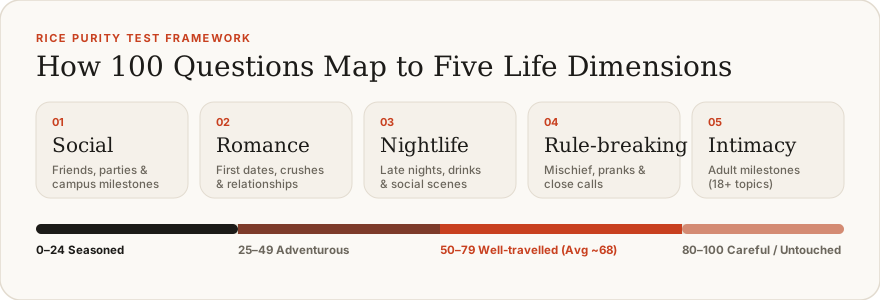
How the Rice Purity Test Score Is Calculated
The classic scoring formula is intentionally simple: everyone starts at 100 points, and each “Yes” answer subtracts exactly one point. If you answer “Yes” to 28 of the 100 questions, your final Rice Purity Test score is 72. Answering “Not yet” leaves your remaining points unchanged.
Where legacy checklist sites stop at a single raw number, PurityTestLab adds two modern improvements while preserving 100% mathematical fidelity with the traditional scoring scale. First, every prompt is mapped to one of five descriptive dimensions—Social, Romance, Nightlife, Rule-breaking, and Intimacy—so your results include a five-point radar chart explaining where your points came from. Second, our skip option lets you omit sensitive items without forcing a false answer, transparently displaying your estimated range instead.
Rice Purity Test Score Meanings & Average Benchmarks
One of the most common questions after finishing the Rice Purity Test is what a specific number actually means. Because the survey is descriptive rather than judgmental, each band simply reflects a different mix of life stages and personal choices:
Untouched
Almost every page unwritten. Common among younger takers or people who strongly value quiet routines.
Careful
Classic social and early romantic milestones checked, while avoiding nightlife or rule-breaking detours.
Well-travelled
The collegiate sweet spot. The historical median across university cohorts sits near 68.
Adventurous
Broad experience across romance, nightlife, and bold stories, common among older graduates and travelers.
Seasoned
Rare territory reflecting extensive adult milestones and unconventional campus or life adventures.
Context matters just as much as the raw number. Based on published collegiate survey distributions (1924–2024), the average Rice Purity Test score shifts steadily with age: 18–20-year-old students average around 74, 21–24-year-olds average around 67, 25–29-year-olds average around 61, and adults aged 30+ average near 55. Use the cohort selector in your live sidebar or result report to compare your Rice Purity Test score against peers in your own age group.
Three Ways to Take the Rice Purity Test
Not everyone wants the exact same length or tone every time they take the Rice Purity Test. At the top of the quiz card, you can switch instantly between three curated editions:
- Standard · 100: The canonical 100-question Rice Purity Test preserving the full traditional sequence, complete with hover tooltips for historic campus slang like “leaving room for Jesus” and “MPS.”
- 2026 Modern · 20: A streamlined two-minute snapshot of 20 core prompts designed for quick mobile sessions and fast group comparisons.
- Wholesome · 20: A PG-friendly edition focused strictly on friendship, dating, and everyday social milestones—ideal for mixed-age groups who want the fun of a campus checklist without mature topics.
Frequently Asked Questions About the Rice Purity Test
What is the Rice Purity Test?
It is a 100-question voluntary self-assessment created in 1924 by students at Rice University and published through The Rice Thresher. Each prompt describes a social, romantic, nightlife, rule-breaking, or adult milestone. People take the Rice Purity Test to reflect on their life experiences and compare scores with friends in a lighthearted, non-judgmental way.
How is a Rice Purity Test score calculated?
Every score starts at 100. For each item you mark "Yes," one point is subtracted from your total. A score of 100 means zero items checked, while a lower number reflects a broader range of completed experiences. If you mark "Prefer not to say," that item is omitted from deduction and shown as a transparent range.
What is considered an average Rice Purity Test score?
Across published collegiate surveys from 1924 to 2024, the median sits near 68, with the most common band falling between 60 and 75. Age makes a noticeable difference: incoming 18–20 college freshmen average around 74, while 21–24 upperclassmen average around 67, and 25–29 young adults average around 61.
Is there a good or bad score?
No. A high number is not morally superior, and a low number is not a flaw. The checklist was designed as a campus icebreaker, not a measure of personal worth. Two people can share the exact same score of 65 while having completely different profiles across romance, nightlife, and rule-breaking.
Are my answers private?
Yes. On puritytestlab.com, the official Rice Purity Test runs 100% inside your browser memory. None of your checkboxes, individual responses, or final numbers are transmitted to a remote database. You can also turn on Privacy Blur or press the Esc key at any moment to hide the quiz behind a plain reading view.
Is puritytestlab.com affiliated with Rice University?
No. PurityTestLab is an independent educational and entertainment project and is not affiliated with, endorsed by, or sponsored by Rice University or The Rice Thresher. We preserve the classic 100-question tradition while modernizing its privacy, cultural glossary, and five-dimensional breakdown.
Score Meanings & Archetypes
Explore all five score tiers, archetype profiles, and why identical numbers can tell very different personal stories.
All 100 Questions & Glossary
Browse the full 100-question directory with regional US, UK, India, and Brazil adaptations plus a campus slang glossary.
1924–2026 Centennial History
Read how the Rice Purity Test evolved from a 1924 campus newspaper survey into a privacy-first global tradition.